Podcast: Eager to Be Healthy
Guest: Vanessa Cook, founder of Starlight & Sage Wellness
Host: Michael Scott Eger

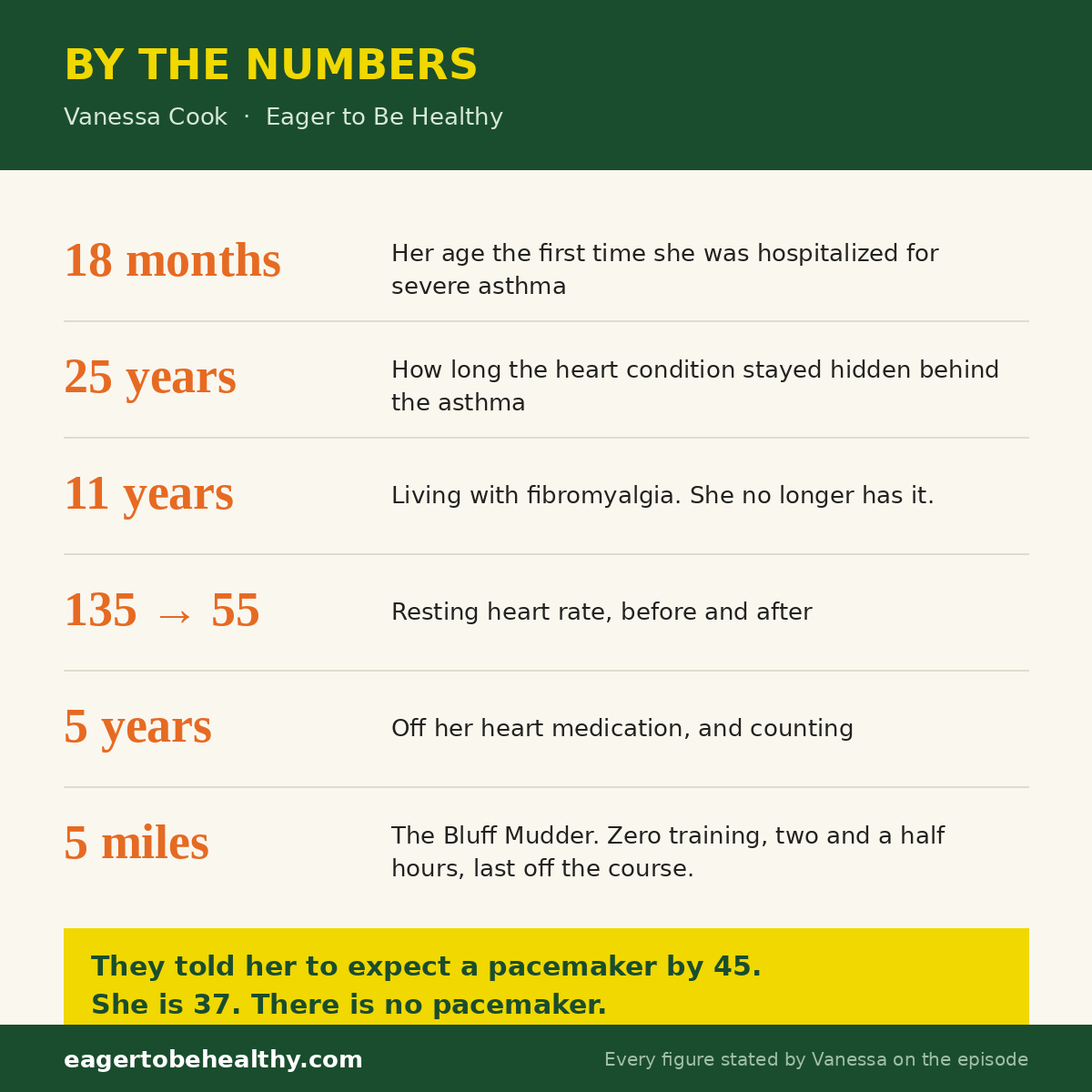
Vanessa Cook was told she would have a pacemaker by the time she turned forty-five.
She is thirty-seven now. No pacemaker. She has been off her heart medication for almost five years. Off her asthma medication. Off the medication she took through eleven years of fibromyalgia. Her resting heart rate used to sit around 135 — the number a healthy person hits climbing stairs. It sits in the mid-fifties today.
She got there by running. And by asking a question most of us are never taught to ask.
Vanessa was first hospitalized at eighteen months old, for severe asthma. That set the pattern for the next three decades — emergency rooms, missed school, a body that seemed to be actively working against her. “I often told everyone that my body hated me and that I wanted a new body,” she said. She could not remember what it felt like to not be in pain.
The heart condition hid behind the asthma for twenty-five years. She would pass out. Doctors assumed she couldn’t breathe. Someone would administer an EpiPen, and eventually she would come back. It took a cardiologist happening to be working the right emergency room, reading the right EKG, to find the electrical problem underneath it all. He told her she was fortunate to be alive. Every one of those EpiPens had been pouring fuel on exactly the wrong fire.
Sit with that for a second. Nobody in that chain was negligent. Every provider treated the symptom in front of them, correctly, one at a time. And the actual picture went unread for a quarter century.
The night it turned
Vanessa married at eighteen, had her oldest son, and was divorced not long after. Her first husband wasn’t equipped to be married to someone that sick. Few people are.
She met her current husband about fifteen years ago. She was unwell for most of the first half of that marriage, and she says plainly that he absorbed a lot.
Then one night he cried and told her he thought she was going to die. That he was going to be a widower raising their children alone. She was twenty-nine, sitting at the bottom of the stairs because she couldn’t get herself up to bed.
Something in her went off. Not I want to feel better. Something closer to: he cannot do this without me.
That’s the actual starting gun. Not a wellness epiphany. A calculation about the people who depend on her.
The Bluff Mudder
A few days later, she signed up for a five-mile obstacle course.
The Bluff Mudder is a real event — the Camp Douglas Armed Forces Day run in Camp Douglas, Wisconsin, out through the Back Forty trail and into the bluffs. Five miles of hills, logs, obstacles, mud.
Vanessa is four foot nine. At the time she weighed close to two hundred pounds and had not walked a mile, let alone run five. She went in with zero training.
It took her two and a half hours. She vomited for most of it. She cried for most of it. She was the last person off the course.
She crossed the line, collapsed, and announced she was never doing anything like that again.
Then she said the thing that actually matters: it taught her she could do hard things. She just didn’t need to kill herself doing them.
Eight years later, she’s an ultramarathon runner. Running is the practice that keeps her the healthiest version of herself, and the place she goes to sort out what’s happening emotionally and spiritually. But she didn’t get there by repeating that day. She got there by never repeating that day.
The spinach
Vanessa did every trend. Every diet, every eating protocol, every hot-button thing in wellness. None of it moved the needle.
Then she found the spinach.
She’d been eating a lot of it. Of course she had. Spinach is the shorthand for eating well — it’s what you add to the plate when you’re trying. And it turned out to be one of the foods her body didn’t want.
She’d assumed all vegetables were healthy. Some of them just weren’t healthy for her.
That’s the episode in one vegetable. Not that spinach is bad. That “healthy” describes a pairing — a food and a person — and we keep talking about it like it belongs to the food alone.
Her own approach now leans paleo. Dairy-free, gluten-free, no refined sugar, whole foods wherever possible. Nothing boxed if she can help it. The rule she hands every client is the simplest one on the internet: five ingredients or less. If a package clears that bar, it’s close enough to real food to bring home.
She also mentions, almost in passing, that she lost about eighty-five pounds — and still didn’t feel great. That’s when she started therapy. The physical work got her partway. It took the emotional work to finish the job.
Worth noticing that order. She did the thing everyone tells you to do, succeeded at it, and it wasn’t enough.
Symptoms are messages
Here’s the frame Vanessa builds everything on: your body isn’t malfunctioning. It’s talking.
Brain fog, digestive trouble, hormone chaos — she treats these as communication rather than problems to be silenced. Her concern with conventional care is that it’s trained to shut the signal off. Find the symptom, find the medication that quiets it, move to the next patient.
Mike put it back to her in one sentence: symptoms are diagnostic signals, and if we medicate them, we lose those signals.
She said that was a better summary than the version she’d just given.
And she pushes it past the physical. In her experience, when someone has the nutrition and the movement sorted and still can’t get where they want to go, the stuck part is usually emotional or spiritual. The doctor’s visit does not have room for that. There’s a question about depression, a question about anxiety, a question about stress, and a prescription pad.
Fifteen minutes a year
Mike’s contribution to this one is the sharpest thing in the episode.
His doctor wanted to treat his blood pressure. He pushed back — fix the blood sugar first, then we’ll talk about blood pressure meds and statins. A year later the numbers had moved on their own.
That conversation is available to almost everyone and almost nobody has it.
Your doctor might get fifteen minutes with you a year. You are in your body every minute of every day. Even with zero medical training, you can read. Yes, some of it will be Dr. Google. Some of it will be Dr. Grok, or Dr. Claude. But if you keep collecting, and you keep asking how and why, and you ask it in a few different ways, you slowly acquire a real education in your own condition.
Then you take that to a competent provider and say: this doesn’t add up to me. Can we try this first?
The alternative is the version we’ve all seen. One medication treating a symptom. A second medication treating the first one’s side effects. A third for the second. Wake up one day with a shelf full of bottles and no idea which one is doing what — and then wonder why everybody in the nursing home seems so far away.
Vanessa’s closing thought was about exactly that. Advocate for yourself. Trust your intuition. And understand that there is a great deal out there nobody has bothered to teach you.
Key Takeaways
- A symptom is a signal. Medicating it away can cost you the information underneath it.
- No protocol is universal. Vanessa’s turnaround started when she stopped chasing trends and started paying attention to her own body.
- Your doctor gets fifteen minutes with you a year. You get 24/7. Showing up educated changes the conversation.
- Capability is built in small decisions, not dramatic ones. The finish line mattered less than the eight years after it.
Where to find Vanessa
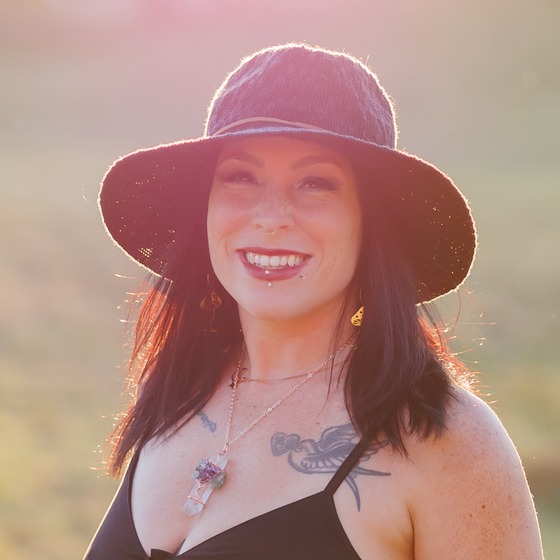 Vanessa works one-on-one, and she starts everyone in the same place: a complimentary discovery call. Not a program pitch. A conversation about what’s actually going on.
Her reason is consistent with everything above. People come to her saying they want to lose weight, and her first question is how their mental health is. Sometimes the plan that comes out of that is holistic health coaching. Sometimes it’s trauma work. Usually it’s some combination nobody would have guessed at the start.
Vanessa’s bio, in her words:
I’m the founder of Starlight & Sage Wellness, a wellness education company dedicated to helping individuals and organizations better understand stress, resilience, and whole-person well-being. As a keynote speaker, holistic healing practitioner, and wellness educator, I blend evidence-informed education with practical strategies to help people reconnect with their mind, body, and spirit.
Drawing from my own journey of overcoming chronic stress and transforming my health, I speak on nervous system regulation, burnout, women’s wellness, behavior change, and sustainable lifestyle habits — through keynotes, corporate wellness programs, workshops, breathwork, and coaching. My mission is simple: to help people stop fighting their bodies and start understanding them.
Healing isn’t about becoming someone new. It’s about coming home to yourself.
When I’m not talking about wellness, I’m probably out running trails, training for my next endurance challenge, hiking, or planning our next family adventure. I’m a mom of seven, so life is full, loud, and wonderfully unpredictable.
Find her at starlightandsagewellness.com.
Always consult your healthcare provider before making changes based on health content.
Eager to Be Healthy runs on Value for Value. No ads, no sponsors — just listeners who decide it’s worth something.
Full Transcript
Lightly edited for readability. Speaker turns preserved.
Vanessa Cook: Hi, my name is Vanessa Cook and I’m eager to be healthy.
Michael Scott Eger: Your body is not working against you. It’s telling you something, and most of us were never taught the language. Vanessa Cook is the founder of Starlight & Sage Wellness. She is a holistic healing practitioner, an educator who teaches science without burying you in it, and a keynote speaker. Her focus is nervous system regulation, burnout, and women’s wellness. She uses that knowledge in workshops, corporate programs, one-on-one coaching, and when speaking to our audience. Her goal is simple: stop fighting your body and start understanding it. Healing isn’t about becoming someone new, it’s about coming home to yourself. Vanessa, welcome to Eager to Be Healthy.
Michael Scott Eger: We are a value-for-value podcast. We have no ads. So if you would like to support the mission, just go to eagertobehealthy.com/support. Now — have you always been healthy?
Vanessa Cook: I have not.
Michael Scott Eger: Well, how so?
Vanessa Cook: I was born with severe asthma, and I had asthma until I was thirty years old. I was also born with a heart condition, and after I had my first son I had fibromyalgia for eleven years. So I dealt with a litany of immune issues and peculiar sicknesses, and I did not know what it felt like to be healthy until I was thirty.
Michael Scott Eger: Have you always been happy?
Vanessa Cook: Also, I have not. I didn’t find happiness until I began my healing journey through my emotional and spiritual well-being. For the majority of my life I struggled pretty greatly with significant trauma that I experienced, and with a lot of resentment and anger.
Michael Scott Eger: So what started the journey?
Vanessa Cook: My journey started when I was very, very unhealthy. My husband was really afraid that he was going to lose me — that I was going to pass away, because my health had been declining pretty significantly in the years that we were married. He saw what was happening to not only my body, but my mental state and my spiritual state. And so he cried one day and said that he thought I was going to die and that he was going to be a widower with our children. Something in my brain kind of went off and said, I can’t leave my husband with our children, he won’t be able to make it.
Vanessa Cook: So I started researching other ways to be healthy that were not through Western medicine, because unfortunately the doctors and medications and everything that I had been exposed to my entire life — nothing seemed to resolve my issues, and most of the time it made it worse. I began researching and educating myself on holistic health, and then that led me into going to schooling, and then here I am today.
Michael Scott Eger: So when exactly did this start?
Vanessa Cook: I was a year and a half old the very first time that I was hospitalized, and it was because of severe asthma.
Michael Scott Eger: And the heart condition?
Vanessa Cook: We did not find out that I had a heart condition until I was in my mid-twenties. It was masked by my asthma. I would have these episodes where I would end up passing out, and the doctors believed it was a result of me not being able to breathe. They had actually given me an EpiPen, and someone would administer the EpiPen to me, and then eventually I would come back to.
Vanessa Cook: Then one day I went into an emergency room and luckily had a doctor who specialized in cardiology. He looked at my EKG and realized that I had an electrical issue with my heart. And then we went to the cardiologist, who told me that I was very fortunate to be alive — because the amount of times that we used the EpiPen on me, it could have actually stopped my heart. It was exacerbating the electrical issue that was wrong with my heart.
Michael Scott Eger: Do you have a pacemaker now?
Vanessa Cook: I do not. Initially they said I would have a pacemaker by the time I turned forty-five. I’m thirty-seven now, and off of all of my medication for my heart condition, and off of medication for asthma and fibromyalgia. I no longer have asthma or fibromyalgia. My heart condition is still there, but it’s managed just by my healthy choices and my activity.
Michael Scott Eger: So you have a protocol for your heart. Is that what you’re saying?
Vanessa Cook: It’s mostly just staying active and ensuring that I’m eating whole foods, and adding any herbs and supplements that I need to keep me going healthy. When I went to the cardiologist, my resting heart rate was about 135, which is very, very high for a resting heart rate. Now my resting heart rate is mid-fifties to sixties on average. I began running, and running significantly helped me as well. But no protocol specifically — it’s all about being mindful and ensuring that I’m eating as much whole food as possible versus ultra-processed foods.
Michael Scott Eger: Those numbers, especially resting heart rate — that is a major change.
Vanessa Cook: Yes, absolutely. The cardiologist was pleasantly shocked when I came in to ask to be removed from the medication I was on for my heart. He told me that with the condition I have, most people would never be off medication. But the medication I had been on was actually contributing to my heart rate being too low, especially during exercise. So he agreed to taper me off, and I have not been on that medication for almost five years now.
Michael Scott Eger: That’s five years where you’re refining your protocols.
Vanessa Cook: My outlook on health is that it is never a one-size-fits-all. It’s all about the individual human. When I first started my health journey, I kind of followed all the trends. I did every trend that you can think of — diet trends, eating trends, whatever was perceived to be the hot button in holistic wellness. And nothing worked for me.
Vanessa Cook: Then one day I had been reading about ancestral lineage — historically speaking, what certain groups of people would generally eat or experience. And I learned about a gentleman called William Wolcott. He did a lot of studying about the human condition and epigenetics, and that led me to recognize that I needed to apply those same things to myself and understand that I needed to figure out what my body needed specifically. So that’s what I do today for my clients. I help support them and figure out what’s going to be best for their bodies. It’s a little bit of work on their part and of course on my part, but it’s also a lot of intentionality — ensuring that they get what they need specifically, and not that standard one-size-fits-all process.
Michael Scott Eger: Yes, because when you go online there’ll be these cool, confident people coming on saying this is the greatest thing since sliced bread. And while sliced bread was an innovation, it doesn’t mean it’s right for everyone. Some people might be gluten sensitive. And that wasn’t planned as a joke.
Vanessa Cook: Absolutely. And I think we as a society got away from that. Here in America with our doctors, it’s a one-size-fits-all treatment plan as well. I’m a huge proponent of understanding when Western medicine is appropriate and when alternative medicine is a better choice or fit, depending on the individual.
Vanessa Cook: I genuinely followed all of the trendy things. And even things that are seemingly healthy for one person can actually be very unhealthy for the next person. I have a food sensitivity to spinach. I was eating a lot of spinach because I was told spinach was healthy and good for you and I was trying to do all of the things — and I had been exacerbating my condition because I was eating foods that weren’t appropriate for my body specifically. I also do functional medicine testing with my clients. When I did a food sensitivity test for myself, I learned what foods I needed to stay away from, and I was really shocked to find some veggies on there. I thought all veggies were healthy, and then I found out it wasn’t as healthy for me — specific ones.
Michael Scott Eger: Each food occurs differently to everyone, but it still means you should try to find foods that work for you.
Vanessa Cook: Absolutely.
Michael Scott Eger: So going through this process, especially at a very young age, did that affect your mental health?
Vanessa Cook: Yes, it did. Other than some of the significant trauma that I had gone through in my childhood with my family members, and some other series of unfortunate events that took place in my life, my health really affected my mental health. I often told everyone that my body hated me and that I wanted a new body. I genuinely thought that for the rest of my life I was going to be in pain. I didn’t remember what it felt like to not be in pain. I’d never gotten to experience what breathing appropriately felt like, because I always struggled to breathe as well.
Vanessa Cook: When I was young I wanted to go into nursing school, and I ended up not being able to, because my doctor told me if I continued down the path of being in the medical field I would actually end up dying — my immune system was so weakened. Every time I would go into a hospital, or the nursing home I was working at, I’d catch everything. I was constantly sick, constantly going into the emergency room. So I had to pivot. And it wasn’t until five years ago that I recognized I wanted to be in the wellness field, and that I would have the ability to do so, because I finally became strong enough in my immune system and my mental health and physical body to do it again.
Michael Scott Eger: Just a side note, speaking from experience — it takes a couple of years working in health and wellness, in direct care, to develop a rock-hard immune system. You will be exposed to a lot of different things, and it takes some time.
Vanessa Cook: Absolutely. I agree.
Michael Scott Eger: So did these feelings progress into married life, or did you develop emotional health earlier?
Vanessa Cook: When I was eighteen I got married and had my oldest son, and it very quickly ended in divorce, because I wasn’t well and my husband at the time was not equipped emotionally to handle someone who was so sick. Our marriage fell apart very quickly. Then I spent quite some time being a single mother. And then I met my current husband. We’ve been together for almost fifteen years.
Vanessa Cook: I was very unwell through, I would say, the first half of our marriage. He’s a really amazing human being and dealt with a lot of my crap, I’ll say. And it wasn’t until he gave me that nudge of, hey, I don’t think you’re going to make it past the age of thirty-five if you stay on this path. So once I got healthy — I had lost about eighty-five pounds — I was wondering, man, how come I still don’t feel great? And then I decided to pursue therapy. Through mental health healing I was finally able to come full circle and be the happiest I’ve ever been in my life. As a result of that, my husband and I have a pretty incredible marriage now.
Michael Scott Eger: It’s always better to get the improved version later in the marriage.
Vanessa Cook: Instead of regressing. Everyone does that, right? They show the best version of themselves right away, and then as you continue to go through, you’re like — you’re not really that same way. So now he gets a happy surprise.
Michael Scott Eger: I learned that I couldn’t fake it that long, so I stopped doing that.
Vanessa Cook: And then you end up not being happy yourself, when you get into relationships where you feel like you have to be at a level 100 when typically you operate at a level 60. I wholeheartedly believe that there is someone out there for everyone, and we just have to be patient enough to find who that person is for us.
Michael Scott Eger: Let’s talk about the Bluff Mudder.
Vanessa Cook: The Bluff Mudder?
Michael Scott Eger: Yeah, we should segue into that. Because I got your notes and our listeners don’t. So what prompted you to do this?
Vanessa Cook: It was trendy back then. Like I said, when I initially started my health journey, I thought — what do I need to do? I thought that being skinny was being healthy. I’m four foot nine, so I’m very short, and I was almost two hundred pounds. So I thought that it was a really great idea to kick-start my health journey with a Bluff Mudder.
Vanessa Cook: It’s a five-mile obstacle course, designed to mock a Tough Mudder — and a Tough Mudder is a ten-mile obstacle course. So for some reason I thought, it’s five miles, it can’t possibly take me that long. Let’s give it a go. And I went into that Bluff Mudder with zero training. I hadn’t even walked a mile at that point, let alone five, let alone trying to run five miles and go through nature and dumpsters. There was mud everywhere.
Vanessa Cook: I failed miserably. It took me two and a half hours to complete the course. I was the very last person off the course, and I vomited almost the entire time and cried the entire time. But I crossed the finish line, collapsed on the ground, and said that I was never going to do anything like that again. And thankfully, it did kick-start me into realizing that I could do hard things. I just didn’t need to kill myself doing those hard things.
Michael Scott Eger: Why don’t we just transition to more challenging things slowly?
Vanessa Cook: Exactly. And now I’m an ultramarathon runner, and running is kind of my passion. It’s been the thing that has helped keep me what I would deem the healthiest version of myself. It gives me some time to escape reality and really focus on what’s needed emotionally and spiritually for me. So it was a really crazy, silly thing to do at the time, but it is something that has lasted in the eight years now that I have been on my wellness journey.
Michael Scott Eger: Just for informational purposes, what’s your preferred diet?
Vanessa Cook: I lean towards a paleo-like diet. I’m dairy-free, gluten-free, refined-sugar-free, and I eat as many whole foods as possible. I don’t buy anything that is boxed or ultra-processed. And if I do buy something that would be deemed ultra-processed, I have a rule that I give to all of my clients, and it’s five ingredients or less. If I grab something that’s packaged and it has five ingredients or less, then I know that it’s safe and it’s as close to whole food as possible.
Vanessa Cook: That’s what has worked for my body specifically. And I highly encourage the majority of my clients to attempt to reduce as many inflammatory foods as possible. Unfortunately here in the United States, our gluten is very inflammatory. And unfortunately dairy, for the majority of people, is inflammatory as well — especially for women. Women’s sex hormones do not regulate appropriately when they’re consuming a lot of dairy. It’s because of the antibiotics and the hormones that are in the dairy products as it is. There are a couple of other things I could rabbit-hole down about dairy specifically. But for my women, I try and have them gravitate towards something like goat milk or sheep milk — something that’s closer related to human anatomy in terms of the DNA makeup of the dairy, versus cows, which have a very different DNA makeup than human milk.
Michael Scott Eger: Do you find any difference between fermented versus fresh?
Vanessa Cook: For dairy, you mean? I have had raw milk before, which I know is very difficult to get a hold of in most places. My body specifically still did not tolerate it. And I work primarily with women, so I’ll caveat it by saying — women typically do much better with the hormones that help them regulate their entire existence, pretty much, when they’re off of dairy.
Vanessa Cook: I always call it a big win if we can transition their lifestyle to something like coconut or almond milk. I try really hard to make sure that it’s unsweetened coconut milk, unsweetened almond milk. And now it’s 2026, so we have access to plant-based cheeses, which is really incredible. And then just really making sure that they’re focusing their nutrition on getting protein from whole food sources, versus what people traditionally do with a lot of dairy consumption.
Michael Scott Eger: Why don’t we focus on the whole body — and why conventional medicine siloing different symptoms and body parts misses many issues.
Vanessa Cook: I truly believe that symptoms are not something to be looked at as problems. I look at symptoms as the body’s way of communicating with us. So when you have things like brain fog or digestive issues or hormone issues, unfortunately Western medicine is taught that they need to fix those problems, and they find medications or other means to silence those symptoms so that you can feel as though maybe you’re getting better — but in reality it’s your body’s way of communicating something to you.
Vanessa Cook: I believe that things like digestive issues or hormone issues or brain fog, or some of the other common issues that you get on a regular basis, are actually more than just a physical issue. It can be an emotional and spiritual issue as well. Oftentimes, especially with women, when they’re not able to release the weight that they’re wanting to, or if they’re not able to regulate their hormones appropriately, it’s because they have the physical part of it figured out, but their emotional and spiritual lives are in disarray — which creates additional chaos and can continue those symptoms.
Vanessa Cook: And Western medicine unfortunately isn’t going to delve that deeply into it. A doctor isn’t going to continue to ask you questions about your mental health or your spiritual well-being. They just have the surface-level questions. Are you depressed? Are you anxious? Do you have an abnormal amount of stress in your life? You do? Here’s a medication for that. So I look at the whole-body approach, and I ensure that people understand that there are other modalities to healing — especially in terms of trauma healing and breathwork and sound healing, modalities that aren’t the common answer for Western medicine.
Michael Scott Eger: So what I heard was that symptoms are diagnostic signals, and if we medicate them, we lose those diagnostic signals.
Vanessa Cook: Absolutely. That was a great recap of everything I just said.
Michael Scott Eger: When my doctor was complaining about my blood pressure, I had to argue that we need to fix my blood sugar first before we even consider blood pressure meds or statins. And then a year into it, they’re like — you know what, your numbers are better.
Vanessa Cook: That’s amazing. And it’s so cool when you get to advocate for yourself and then you see the success in saying, hey, wait a minute, I want to try this first. A lot of people don’t know that they can do that.
Michael Scott Eger: And the thing is, those doctors might have only fifteen minutes with you a year. You’re in your body twenty-four seven, three hundred and sixty-five days a year. Even if you have zero medical experience, you can still do some research. Yes, it’ll be somewhat Dr. Google. It might be Dr. Grok. It might be Dr. Claude. But the point is, if you start collecting, and you start asking how and why, and you ask in different ways, you start getting a medical education on your condition.
Michael Scott Eger: And if you work with a medical provider that’s competent, and you advocate for yourself and say this doesn’t make sense, can we try this first — you get much better results. But if you just sit there and blindly take the pills, you wake up one day with a hundred bottles of prescribed medicine. One symptom is being treated by one medicine, and another medicine is treating the side effects from a different medicine. And you wonder why in our nursing homes everyone’s so drugged out.
Vanessa Cook: Absolutely. I completely agree with that. And it’s really difficult, because unfortunately now there are incentives for medication to be given. The way that our health system is structured, it’s all about how much money they can get into the system to keep providing care for the humans. And so it’s this vicious, never-ending cycle. It makes me really sad that this is where we’re at in society — versus doing the things that maybe not our parents or their parents, but our great-great-grandparents had learned, living off of the land and nature and resources, and were just as successful as what’s happening now. I would even say more so, with medications that the earth has given us that are natural and healthy, that we don’t have to combat other side effects and symptoms for.
Michael Scott Eger: Is there anything we have not covered that we should?
Vanessa Cook: I think we’ve done a great job covering the whole mind, body and soul thing. The most important thing that listeners can take away from your podcast in general, from what I’ve heard and got to listen to before, is advocating for yourself, really trusting your own intuition, and understanding that there’s so much more out there that we just haven’t been educated on. Learning your own body is so important.
Michael Scott Eger: So if someone would want to work with you, what would that look like?
Vanessa Cook: Because I truly believe that it is about the individual person, and I have a lot of certifications and a lot of different things, I always tell people to book a complimentary discovery call with me, so that we can really delve into their lives and what they’re truly needing. Oftentimes people come to me and they’re like, hey, I want to lose weight. And I’ll say, great — how’s your mental health? And then we actually end up going from a holistic health approach into more of a trauma healing approach, or a combination of it. So I have a litany of different programs that I recommend for people, but every single client that comes to me gets an individualized plan based off of their own needs.
Michael Scott Eger: And where do they go to get this?
Vanessa Cook: The easiest way is to go to starlightandsagewellness.com. There you can explore all of the different modalities that I use in order to support someone on their healing journey, and you also have the ability to book that initial complimentary call with me.
Michael Scott Eger: Well, I want to thank you for coming on to Eager to Be Healthy. With great gratitude, thank you.
Vanessa Cook: Thank you.
Leave a Reply